

Key Takeaways
- AI recruiting software addresses challenges like high application volumes, candidate disengagement, and unconscious bias.
- Implementing AI in recruitment leads to faster hiring cycles, higher-quality hires, and cost savings.
- Greenhouse’s AI recruiting software offers features such as talent rediscovery, automated hiring plans, and resume anonymization to enhance the hiring process.
Primary Challenges in Talent Acquisition Today
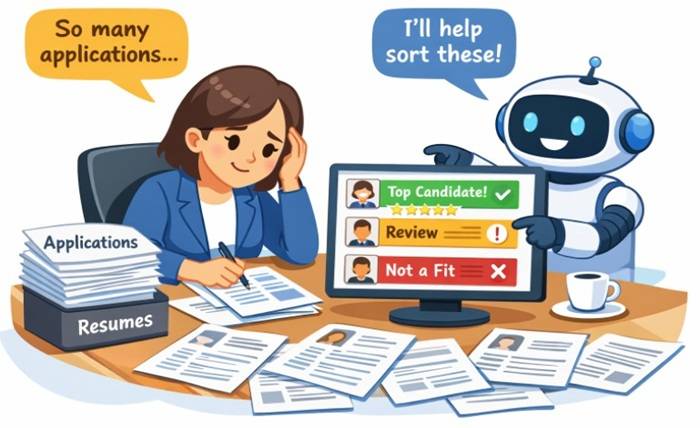
Organizations today encounter several critical challenges in their talent acquisition processes. Firstly, the high volume of applications poses a significant obstacle for recruiters, as they often receive an overwhelming number of submissions, making it difficult to efficiently identify qualified candidates. This accumulation of applications can lead to missed opportunities to hire top talent. Secondly, the phenomenon of candidate ghosting has become increasingly prevalent, in which candidates disengage during the hiring process, resulting in extended time-to-fill and unnecessary resource expenditures. Additionally, bias in hiring is a major concern; unconscious biases may influence decision-making, adversely affecting efforts to promote diversity and inclusion in the workforce. Lastly, reliance on outdated systems can hinder recruitment efficiency, which is why many organizations are turning to AI recruiting software to streamline applicant tracking, reduce bias, and improve overall hiring outcomes.
How AI Recruiting Software Addresses These Challenges
AI recruiting software addresses several hiring challenges by improving key aspects of the recruitment process. It enables efficient candidate sourcing by leveraging AI algorithms that analyze extensive datasets to match candidates’ skills to job requirements, significantly reducing manual search time. Additionally, automated communication tools enhance candidate engagement by ensuring timely follow-ups, helping minimize ghosting, and enriching the overall experience. Furthermore, these tools help reduce bias by anonymizing candidate information during initial screening, enabling a focus on qualifications and skills and fostering fairer hiring practices. Lastly, integrating AI enhances the functionality of the Applicant Tracking System (ATS), refining filtering processes to ensure qualified candidates are not overlooked by outdated or inflexible criteria.
Measurable Benefits of Implementing AI in Recruitment
Organizations implementing AI in their recruitment processes experience notable enhancements, including faster hiring cycles, with reductions of up to 25% in time-to-hire, enabling quicker acquisition of top talent. Additionally, the use of predictive analytics leads to a 20% increase in quality-of-hire scores by more accurately assessing candidate potential. Furthermore, automating repetitive tasks not only streamlines processes but also generates substantial cost savings by reducing reliance on extensive human resources.
How Greenhouse’s AI Recruiting Software Stands Out
Greenhouse provides an all-encompassing AI recruiting solution that enhances the hiring process at every stage. The software features include talent rediscovery, which helps engage past applicants who align with current job openings, thereby broadening the available talent pool without requiring additional sourcing efforts. The platform also features automated hiring plans that create customized interview stages, questions, and scorecards for each role, resulting in a more structured, efficient interview process. Its patented parsing technology enables rapid resume reviews, while anonymization processes redact personal identifiers to reduce bias in evaluations. Additionally, automated interview transcription and analysis deliver critical insights and summaries to support data-driven decision-making in recruitment.
Future Trends in AI Recruiting
The integration of AI in recruitment is anticipated to advance significantly, characterized by three key trends. First, the development of autonomous AI agents will enable systems to independently execute complex workflows, from candidate sourcing to initial screenings. Second, enhancing the candidate experience with AI tools will foster personalized interactions, leading to greater satisfaction and engagement. Finally, a shift towards data-driven decision-making will empower recruiters with advanced analytics, enabling a deeper understanding of recruitment metrics and facilitating ongoing optimization of hiring strategies.
Frequently Asked Questions
How Does AI Ensure Fairness in the Hiring Process?
AI recruiting tools can anonymize candidate data during initial screenings, focusing solely on qualifications and skills, thereby reducing unconscious biases and promoting diversity.
Can AI Recruiting Software Integrate with Existing Systems?
Yes, many AI recruiting solutions are designed to integrate seamlessly with existing ATS and HR systems, enhancing their functionality without requiring a complete overhaul.
Is AI Recruiting Software Suitable for Small Businesses?
Absolutely. AI recruiting tools can be scaled to fit the needs of businesses of all sizes, offering cost-effective solutions that improve hiring efficiency and effectiveness.
What Measures Are in Place to Protect Candidate Data?
Reputable AI recruiting software providers implement robust data security protocols, including encryption and compliance with data protection regulations, to ensure candidate information is safeguarded.
How Quickly Can an Organization Implement AI Recruiting Software?
Implementation timelines vary depending on the complexity of the organization’s hiring processes, but many AI recruiting solutions offer user-friendly interfaces and support to facilitate swift adoption.
By addressing modern talent acquisition challenges with AI recruiting software, organizations can enhance their hiring processes, improve candidate experiences, and secure top talent more effectively.