

Applications of Laser Cleaning Machines in Shipbuilding and Heavy Industry
In shipbuilding, ship repair, and heavy industrial manufacturing, surface treatment is an important step. It affects product quality, coating life, and the stability of later processes. Steel plates, welded structures, storage tanks, pipes, heavy machines, and large steel structures often have mill scale, rust, old paint, oil, salt, and other contaminants on the surface after processing or long-term use. If these surface problems are not cleaned well, they may affect anti-corrosion coating and welding quality. They may also affect the long-term performance of the equipment.
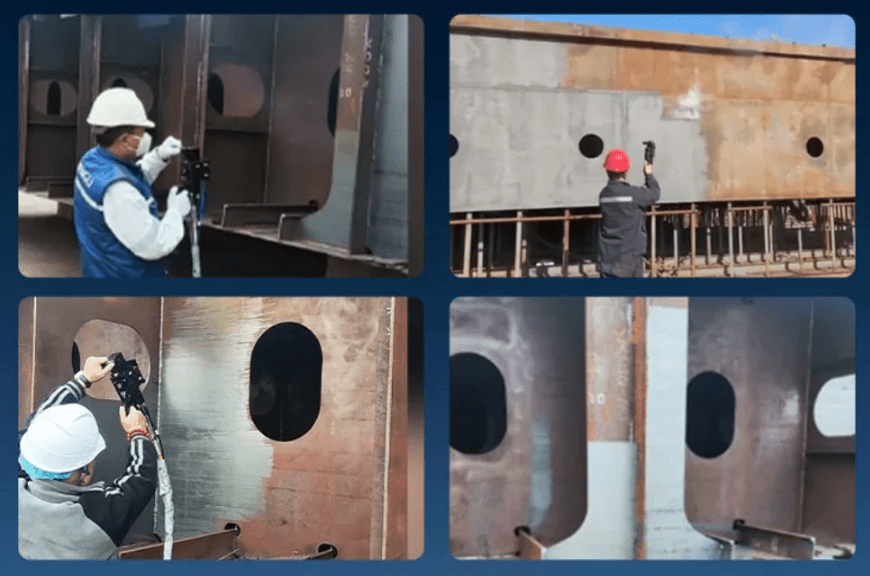
Because of this, laser cleaning machine are being used more often in shipbuilding and heavy industry. Tests from many shipyards and heavy industry companies show that fiber laser cleaning machines can clean marine steel and large industrial equipment surfaces. They can remove mill scale, rust, paint, salt, crude oil, grease, and other contaminants. They can also help the cleaned surface reach a high level of cleanliness. In one HANTENCNC test, a 6000W continuous laser cleaning machine was used. The result showed that it could meet the SA2.5 requirement in ISO 8501.
Why Shipbuilding and Heavy Industry Are Paying More Attention to Laser Cleaning Machines
Ships work for a long time in high-salt, high-humidity, and highly corrosive environments. Because of this, hull steel, decks, bulkheads, and many structural parts can easily form oxide layers and rust. Heavy industrial equipment has similar problems. For example, steel structures, storage tanks, pipes, valves, molds, and heavy machine parts often have oil, old paint, rust, and other industrial dirt after long use.
If mill scale and rust on the steel plate surface are not cleaned in time, or if they are not fully removed, they can have a big effect on later anti-corrosion work and welding work. For heavy industrial equipment, leftover contamination in local areas can affect service life, assembly accuracy, and maintenance efficiency. It can also increase hidden costs for factories.
In the past, cleaning dirt from large equipment surfaces by hand was slow. The results were often uneven, and labor costs were high. Laser cleaning can improve these problems. Based on current market feedback, laser cleaning can clean the surface well, save time, and provide a more stable and controllable base for later processes.
Also, a laser cleaning machine is not only a laser rust removal machine. It can also remove mill scale, rust layers, paint and old coatings, salt, crude oil and grease, dust, loose rust, and other surface contaminants.
Main Applications of Laser Cleaning Machines in Shipbuilding
1. Surface Pretreatment of Marine Steel Plates
Before marine steel plates enter anti-corrosion coating and assembly, the mill scale and dirt on the surface must be removed first. If not, the stability of the later protection system may be affected. According to findings from the Chinese Journal of Corrosion and Protection, the mill scale thickness on the surface of marine hot-rolled steel is about 15–27 μm. If it is not fully removed, it may cause secondary corrosion of the base material and affect the later coating protection.
According to data from the Civil Aviation Administration of China, SA2.5 is a high-level sandblasting rust removal grade in the marine field. It is also a common acceptance standard for heavy-duty ship coatings and new shipbuilding. It requires full removal of all mill scale, rust, and paint. The allowed defect area should be within 5% per square meter. The surface after laser cleaning can meet this requirement.
2. Surface Cleaning Before and After Welding
If oxide layers, oil, or other dirt remain near the welding area, they may affect welding quality and later surface consistency. The advantage of laser cleaning is that the working area is precise and the energy is focused. This makes it suitable for local cleaning around welds. This type of work needs better cleaning quality and better control.
3. Local Rust Removal and Hull Repair
After a ship has been used for a long time, local corrosion is more common. Rust may appear on corners, weld connection areas, and repair areas. These areas are usually not very large, but they need high surface treatment quality. Laser cleaning machines are suitable for accurate local cleaning, especially for grooves, edges, connection areas, and complex parts.
4. Cleaning of Cabins, Ballast Tanks, and Narrow Spaces
In some ship areas with complex inner spaces, traditional surface treatment methods are not always easy to control in detail. A pulsed high-power fiber laser cleaning machine with fiber transmission has a compact structure and flexible beam delivery. This makes laser cleaning more suitable for entering complex areas and doing local surface treatment.
5. Removal of Old Coatings and Local Paint Layers
In ship repair and recoating work, old paint and attached layers often need to be removed in a precise way. Laser cleaning equipment can clean selected areas. This is helpful for later coating, renovation, and surface repair.
Application of Laser Cleaning Machines in Heavy Industry
In large steel structure manufacturing, laser cleaning machines can be used to remove oxide layers, rust layers, and other surface contaminants. In storage tanks, pipes, and valve systems, they can be used for local rust removal and maintenance cleaning. In heavy machines, molds, and high-value parts, they are suitable for work that needs high surface quality and low damage to the base material.
In some heavy industrial maintenance work, surface treatment is not only about “removing dirt.” It also needs accurate cleaning range, controlled heat effect, and stable connection with later processes. Laser cleaning is suitable for this type of work. It has strong potential in local surface renewal, equipment maintenance, workpiece repair, and fine surface cleaning.

Why Laser Cleaning Is More Suitable for High-Requirement Industrial Work
Take a common 500W pulsed laser cleaning machine as an example. At this power level, the center wavelength of the laser is about 1064 nm. The pulse frequency, scanning speed, and working range can be adjusted based on the surface condition. The scanning speed can change in a wide range. In industrial use, a common speed is about 10 m/s. A single working area can cover about 70 × 70 mm².
The mill scale thickness on ship plate surfaces is about 15–27 μm. At a higher scanning speed, one scan can remove about 2 μm. So, several scans are needed to finish the cleaning work. A laser cleaning machine removes dirt based on the workpiece condition. It is not designed to remove everything at once with very high energy.
Also, the cleaning machine not only cleans the surface. It also has a big effect on the next process. After treatment, the surface changes from rough, cracked, and raised to a more even surface. It can also form a certain micro texture. Usually, this type of surface profile can be controlled in the range of 30–80 μm. In ship coating pretreatment, the common surface profile range is about 45–75 μm. With proper settings, laser cleaning can remove the dirt layer and also provide a good surface base for later coating adhesion.
Under proper process conditions, the surface temperature rise during cleaning can be kept low. In general, it can be controlled below 100°C. Even after several scans, the highest temperature is about 63°C. There is no clear sign of serious thermal oxidation. For the later surface condition, the treated area can still keep good surface stability after long-term storage or exposure. This is important for ship repair, ship maintenance, and industrial protection work.
Development Prospects of Laser Cleaning Machines in Shipbuilding and Heavy Industry
For the shipbuilding industry, laser cleaning machines have already shown clear value in marine steel plate pretreatment, cleaning before and after welding, local rust removal, old paint removal, and narrow area cleaning. For heavy industry, laser cleaning machines also have strong application space in steel structure maintenance, storage tank and pipe surface cleaning, equipment renovation, and high-value part surface treatment.
If we want to further expand the business potential of laser cleaning machines, high-power systems are a key research direction. As mentioned above, the treatment efficiency needed for shipbuilding and repair is about 60 m²/h. This means laser cleaning still needs further improvement in equipment capability and process development.
Application Value Summary
The application of laser cleaning machines in shipbuilding and heavy industry has moved from simple technical discussion to real industrial use. It can remove many types of contaminants, such as mill scale, rust, old coatings, oil, and salt. It can also be used in many work areas, including marine steel plate pretreatment, cleaning before and after welding, local repair, cabin cleaning, and heavy industrial equipment surface maintenance.
More importantly, public research has shown that high-power pulsed fiber lasers can reach a high level of cleanliness on marine steel surfaces. They can meet SA2.5 requirements and form a surface profile that helps later coating adhesion. At the same time, with proper parameters, the heat effect stays low and the surface stability remains good.
In the long run, the value of laser cleaning machines in shipbuilding and heavy industry is not only that they “clean better.” Their bigger value is that they help surface treatment become more precise, stable, and intelligent.