

Introduction
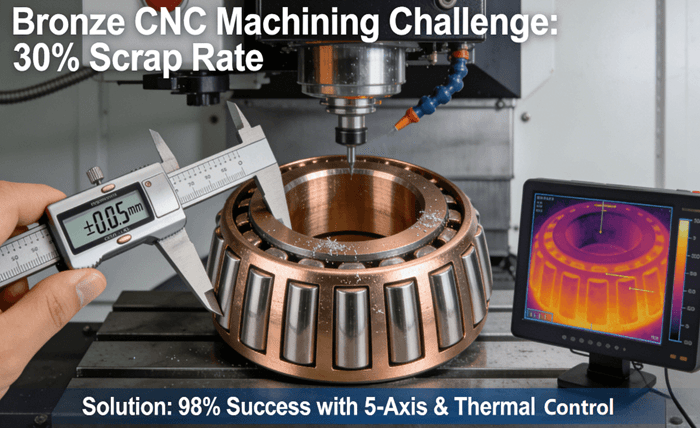
In modern manufacturing, engineers and designers rely on bronze components in applications such as bearings, bushings, and marine hardware, but they face persistent challenges. Industry data shows that scrap rates can reach as high as 30% due to issues such as workpiece deformation, rapid tool wear, and poor surface finish, leading to significant project delays and cost overruns. The root cause lies in a lack of fundamental understanding of bronze’s unique material properties (such as high ductility and thermal sensitivity) and a lack of systematic process control.
This article draws on the successful experience of one company to present a data-driven strategy, including optimized cutting parameters and advanced deformation control techniques, ultimately achieving a success rate of up to 98%. So, how can these challenges be systematically overcome? This guide will delve into the solutions.
What Are the Unique Challenges of Bronze CNC Machining in High-Precision Industries?
Bronze alloys, while offering excellent corrosion resistance and wear properties, present distinct hurdles in a CNC environment. Their high ductility can lead to material adhesion on cutting tools, while uneven heat dissipation during machining can cause thermal deformation, critically impacting dimensional stability. Adhering to stringent standards like ASME Y14.5 for geometric dimensioning and tolerancing becomes exceptionally difficult when these material behaviors are not masterfully managed.
1. The Problem of Material Adhesion and Built-Up Edge
The gummy nature of bronze often causes chips to weld onto the tool’s cutting edge, forming a built-up edge (BUE). This BUE changes the tool’s geometry, leading to poor surface finish on the workpiece and accelerated tool degradation. This issue is particularly acute with certain bronze grades, where inadequate chip breakers or incorrect tool paths exacerbate the problem, directly impacting the final part quality and increasing production costs.
2. Thermal Expansion and Dimensional Inaccuracy
Bronze’s significant thermal conductivity means heat generated during machining is not efficiently carried away by chips, leading to heat accumulation in the part. For thin-walled or complex geometries, this localized heating causes expansion, resulting in machined dimensions that are inaccurate once the part cools to room temperature. This makes holding tight tolerances, especially across large batches, a formidable challenge without precise thermal management strategies.
3. Work Hardening and Its Impact on Machinability
Certain bronze alloys are prone to work hardening, where the material becomes harder and more brittle at the point of cutting if parameters are incorrect. This phenomenon increases cutting forces, can cause micro-cracks on the surface, and drastically shortens tool life. Overcoming this requires a nuanced understanding of the specific alloy’s behavior and the application of precise machining strategies to avoid hardening zones.
How Can Optimized Cutting Parameters Reduce Bronze Machining Defects by Over 50%?
The key to successful bronze machining lies in precisely calibrating the cutting parameters. One company’s experience shows that using a scientific approach to setting cutting speed, feed rate, and cutting depth can reduce the defect rate by more than half. This systematic optimization is not based on guesswork, but rather a rigorous process that conforms to international quality standards such as ISO 9001, thus ensuring product consistency and reliability.
- Establishing the Optimal Cutting Speed Window: For most bronze alloys, a cutting speed between 150 and 300 m/min has been proven optimal. Operating below this range risks built-up edge due to excessive rubbing, while exceeding it can cause premature tool wear from high temperatures. Finding the sweet spot within this window for a specific bronze grade is critical for achieving a clean shear cut, efficient chip evacuation, and a superior surface finish.
- The Critical Balance of Feed Rate and Depth of Cut: A moderate to high feed rate is often necessary to promote the formation of thicker chips that can carry heat away effectively. Conversely, the depth of cut must be carefully managed; too shallow a cut can cause tool rubbing on the work-hardened surface, while too deep a cut can induce vibration and chipping. The synergy between these parameters, often adjusted through adaptive machining controls, is vital for stable and efficient material removal.
- Implementing ISO 9001 Process Controls for Consistency: Adhering to a robust quality management system is what transforms individual parameter optimizations into a repeatable, high-yield process. ISO 9001:2015 mandates documented procedures, continuous monitoring, and corrective actions, ensuring that every batch of precision bronze components is produced under the same controlled conditions. This systemic approach is non-negotiable for achieving the reported 50% reduction in defects consistently.
What Techniques Prevent Deformation in Thin-Walled Bronze Components?
Preventing deformation is arguably the most critical challenge in high-precision bronze machining, especially for delicate thin-walled parts used in aerospace and medical equipment. Combining pre-machining stress relief with intelligent tool path strategies has increased yield rates from 65% to 98% in existing case studies.
1. Pre-Machining Stress Relief through Annealing
Raw bronze stock can contain internal stresses from previous manufacturing processes like casting or rolling. Machining without relieving these stresses can cause the part to warp unpredictably. A controlled annealing process before machining homogenizes the material’s internal structure, significantly reducing the risk of deformation during and after the CNC process, forming a stable foundation for precision work.
2. Symmetrical and Multi-Axis Machining Paths
Employing symmetrical toolpaths ensures that material is removed evenly from all sides of a part, preventing the introduction of new, unbalanced stresses. Furthermore, the use of 5-axis CNC machining allows the tool to approach the workpiece from optimal angles, maintaining a consistent cutting force and minimizing the risk of distorting thin walls. For instance, in a specialized bronze CNC machining services, a layered, multi-directional approach can be used to maintain structural integrity throughout the operation.
3. Fixturing Design for Minimal Clamping Stress
The method of holding the workpiece is paramount. Customized vacuum chucks or soft jaws are designed to distribute clamping forces evenly over a larger area, avoiding localized pressure points that can cause deformation. The fixturing strategy is often a key part of the Design for Manufacturability (DFM) analysis provided by expert manufacturers to ensure the part remains stable and true to its intended geometry.
How Does Material Science Influence Bronze Selection for Sustainable Manufacturing?
The choice of bronze alloy directly impacts not only performance but also the environmental footprint of production. Understanding the material science behind different bronze types — such as phosphor bronze versus aluminum bronze — enables manufacturers to make selections that enhance durability and promote sustainability.
1. Performance Characteristics of Common Bronze Alloys
Phosphor bronze is renowned for its excellent fatigue resistance and spring properties, making it ideal for electrical components and springs. Aluminum bronze, on the other hand, offers higher strength and superior corrosion resistance, suited for heavy-duty marine applications. Selecting the right alloy based on functional requirements is the first step toward sustainable manufacturing, as it ensures longevity and reduces the need for premature replacement.
2. The Role of Certification in Sustainable Practices
Adherence to environmental management standards like ISO 14001 signifies a commitment to sustainable operations. This includes optimizing material usage to minimize waste, implementing coolant recycling systems, and ensuring responsible sourcing of raw materials. These practices, embedded within a certified management system, demonstrate how advanced manufacturing technology can align with ecological responsibility.
3. Lifecycle Analysis and Cost-Effectiveness
A sustainable manufacturing approach considers the entire lifecycle of a component. A more durable bronze part, though potentially higher in initial material cost, may offer significant savings through reduced maintenance, longer service life, and higher reliability. This long-term perspective is essential for economical and environmentally conscious production.
How Can Manufacturers Implement a Cost-Effective Bronze CNC Machining Strategy?
Achieving high precision and quality does not have to come at an exorbitant cost. A strategic approach that leverages batch optimization, DFM support, and advanced tooling technologies can deliver significant cost savings for both prototyping and mass production.
- Leveraging Volume Discounts and Batch Production: Consolidating orders into larger batches allows for better utilization of machine time and more efficient material purchasing, leading to substantial per-part cost reductions. For projects requiring high-volume production, this strategy is key to achieving economies of scale without compromising on the stringent quality controls necessary for bronze components.
- The Critical Importance of Early DFM Analysis: Design for Manufacturability (DFM) feedback provided at the quotation stage is invaluable. Experts can suggest slight design modifications — such as adjusting corner radii or wall thicknesses — that dramatically simplify machining, reduce cycle times, and lower costs. Engaging with a partner that offers comprehensive DFM analysis is a proactive step toward cost-effective manufacturing.
- Investing in Advanced Tooling for Long-Term Savings: While advanced tooling like diamond-coated end mills represents a higher initial investment, their extended tool life and ability to maintain sharp cutting edges result in lower tooling costs per part, reduced machine downtime for tool changes, and consistently higher surface quality. This makes them a financially sound choice for long-run projects, contributing to the overall efficiency of the machining process.
Conclusion
Precision bronze CNC machining, when approached with a systematic methodology, transforms from a high-risk process into a reliable and efficient solution. By mastering optimized cutting parameters, implementing robust deformation control techniques, and making informed material selections, manufacturers can overcome the primary industrial challenges. This holistic approach, integrated with quality and environmental management systems, paves the way for achieving exceptional success rates and cost-effectiveness, solidifying bronze’s role in advanced manufacturing.
FAQs
Q1: What is the typical tolerance achievable for bronze CNC machined parts?
A: Bronze CNC machining can achieve tolerances as tight as ±0.005mm, adhering to standards like ASME Y14.5. Consistent results are ensured through rigorous process controls aligned with ISO 9001 standards.
Q2: How does bronze compare to other materials like steel in CNC machining?
A: Bronze offers superior corrosion resistance and machinability in many cases but requires specific parameters to avoid issues like work hardening. Expert knowledge is key to balancing performance and cost-effectiveness for a given application.
Q3: Can bronze CNC machining be used for high-volume production?
A: Absolutely. With strategies like automated tool changers and optimized batch processing, production can be efficiently scaled from prototypes to tens of thousands of units, maintaining high quality and competitive pricing.
Q4: What certifications are critical for quality assurance in bronze machining?
A: ISO 9001 is fundamental for quality management, while AS9100D is essential for aerospace applications. These certifications validate a commitment to traceability and consistent excellence.
Q5: How do I choose the the right surface finish for bronze components?
A: The choice depends on the application’s need for corrosion resistance, wear properties, or aesthetics. Common options include plain machined, polished, or coated finishes. Expert DFM support can guide the selection of the most suitable and cost-effective finish.