

Introduction
In aerospace manufacturing, the high failure rate of gear components often leads to production delays, soaring costs, and significant safety risks, adversely impacting overall project schedules. The core issue lies in the insufficient precision of traditional machining methods, which lack advanced processes and standardized controls, failing to meet the demands of high-intensity applications.
This article presents a solution through the introduction of high-precision gear machining technologies, such as helical gear milling and optimized tool selection, combined with integrated Precision Manufacturing Solutions to enhance component durability and operational efficiency. The following sections will provide a step-by-step analysis of the key technologies and practical applications.
What is Helical Gear Milling and Its Role in Precision Manufacturing?
Helical gear milling is a sophisticated machining process central to modern precision engineering. It involves cutting teeth that are arranged in a helix around the gear’s axis, unlike the straight teeth of spur gears. This section breaks down its principles, advantages, and applications.
The Fundamental Principles of Helical Gear Milling
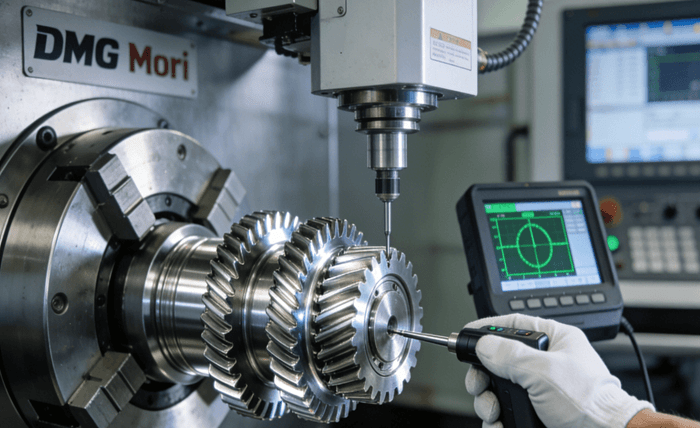
The process is predominantly performed on Computer Numerical Control (CNC) milling machines. The fundamental principle involves a rotating multi-point cutting tool that moves along a helical path relative to the gear blank. The CNC system precisely controls the simultaneous movement of the tool along multiple axes (typically 3 to 5 axes), ensuring each tooth is cut to the exact geometry, helix angle, and surface finish specified in the digital design. This automated, digital approach eliminates human error and guarantees repeatability across production runs.
Advantages in Precision Drive Systems
The helical tooth design offers significant performance benefits that can be categorized into key areas.
- Enhanced Operational Performance
The primary advantage is smoother and quieter operation, as the teeth engage gradually rather than all at once. This gradual engagement also allows helical gears to carry higher loads than similarly sized spur gears, making them ideal for high-torque applications.
- Improved Durability and Longevity
Furthermore, the reduced vibration and impact stress during meshing lead to lower wear and a longer service life for both the gear and its mating components. For industries where reliability is paramount, such as aerospace and robotics, these advantages are critical.
Standardization and Best Practices
To ensure quality and interoperability, the gear industry adheres to strict standards. Organizations like the American Gear Manufacturers Association (AGMA) provide comprehensive guidelines for gear tooth design and manufacturing. Following standards such as those outlined in the AGMA gear design guide ensures that gears meet essential criteria for tooth profile, accuracy, and strength. Adherence to these standards, combined with advanced helical gear machining capabilities, is a hallmark of a reputable manufacturer. This commitment to standardization is crucial for achieving the consistency required in precision applications.
What are the Common Challenges in the Gear Cutting Process?
The gear cutting process on milling machine platforms, while advanced, is not without its challenges. Understanding these hurdles is the first step toward mitigating them and achieving consistent quality.
A primary challenge is tooth profile error, where the final shape of the gear tooth deviates from the intended design. This can be caused by incorrect machining parameters, tool deflection, or thermal expansion of the workpiece or machine tool. Material deformation is another common issue, particularly with heat-sensitive alloys, where the cutting forces and generated heat can alter the material’s properties. Tool wear is an inevitable but manageable problem; as gear cutting tools dull, they produce inferior surface finishes and inaccurate profiles, leading to scrap parts.
These challenges are addressed by stringent international standards. ISO 1328-1:2013, for instance, specifies accuracy grades for cylindrical gears, providing a clear benchmark for quality. To proactively avoid these issues, manufacturers employ simulation software for virtual testing. These Rapid Prototyping Tips allow engineers to identify potential problems in the digital stage, iterating on the design and machining strategy before a single piece of metal is cut. This virtual validation saves significant time and cost by preventing failures during mass production.
How to Select Suitable Gear Cutting Tools to Enhance Efficiency?
Selecting the right cutting tool is a critical decision that directly impacts the quality, cost, and lead time of gear production. The choice depends on the gear type, material, volume, and required precision.
For milling operations, solid carbide end mills are excellent for prototyping and low-volume production of helical gears due to their flexibility. For higher volumes, gear hobs are more efficient for producing spur and helical gears. When it comes to specialized designs like the double helical gear, which features two opposing helices to cancel out axial thrust, the tooling and machining strategy become more complex, often requiring specialized cutters and precise alignment.
The selection criteria extend beyond geometry. The substrate material and coating of the tool are vital. For instance, in Medical Device Manufacturing, where components often require biocompatible materials like specific stainless steels or titanium, tools with sharp, wear-resistant coatings are essential to maintain precision without contaminating the workpiece. A manufacturer’s expertise is demonstrated by its ability to recommend the optimal tool based on the project’s unique requirements. Companies like JS Precision, which hold relevant certifications, leverage this knowledge to ensure that tool selection aligns with industry-specific compliance needs, such as those for aerospace or medical applications.
Case Study of Precision Gear Machining in Aerospace Component Manufacturing
The theoretical benefits of precision gear machining are best demonstrated through real-world application. The following case study illustrates its impact on a critical Aerospace Component.
Project Background and Initial Challenges
A leading aerospace subcontractor faced recurring failures in a helical gear set used within a satellite deployment mechanism. The components were experiencing a 15% failure rate during testing, causing significant project delays and cost overruns. The root cause was identified as inconsistencies in tooth profile and surface finish from their existing machining process.
Implementing a Precision Machining Solution
The subcontractor partnered with a precision machining specialist to redesign the manufacturing process. The solution involved a multi-faceted approach:
- Advanced CNC Machining and Toolpath Optimization:
The gears were machined on a 5-axis CNC milling center using dynamic toolpaths that maintained a constant chip load, reducing tool wear and improving surface finish. - Rigorous In-Process Quality Control:
Each machining batch was subjected to intermediate coordinate measuring machine (CMM) inspections to ensure compliance with the AGMA 12 accuracy standard before proceeding to the next operation.
Measurable Results and Cross-Industry Application
The new manufacturing process yielded dramatic improvements. The failure rate of the gear set was reduced by 40%, eliminating the deployment mechanism as a critical path item. The success of this project highlights how leveraging local expertise—often searched as gear cutting near me—can shorten the supply chain and improve collaboration. Furthermore, the precision and miniaturization skills honed in aerospace are directly transferable to sectors like Consumer Electronics Prototyping, where durability and precision in small mechanisms are equally vital. The entire process was underpinned by a quality management system certified to IATF 16949, ensuring consistent results. For similar high-stakes applications, sourcing precision helical gears from a qualified supplier is imperative.
What are the Future Trends in Gear Cutting Technology?
The evolution of gear machining is driven by demands for greater efficiency, precision, and sustainability. Several key trends are shaping the future of this field.
Automation and digitalization are at the forefront. The integration of AI and machine learning into the helical gear cutting machine enables predictive maintenance, real-time adjustment of machining parameters, and autonomous quality control, minimizing downtime and human intervention. The evolution of types of gear cutting is also progressing, with additive manufacturing (3D printing) being explored for producing near-net-shape gear blanks or even fully functional prototypes, which can significantly reduce material waste.
These advancements directly enhance Rapid Prototyping Tips. The future points toward even shorter iteration cycles, where digital twins and AI-driven simulations will allow for near-instantaneous design validation. According to industry analyses from bodies like AGMA, the integration of these smart technologies holds the potential to increase overall manufacturing efficiency by over 30% in the coming decade, encouraging manufacturers to adopt innovative solutions to stay competitive.
Conclusion
In summary, precision gear machining, underpinned by advanced technologies like helical gear milling and rigorous standardization, significantly enhances component reliability and cost-efficiency. This is particularly critical in high-risk sectors like aerospace, where failure is not an option. By addressing common machining challenges through sophisticated tool selection and process control, manufacturers can achieve new levels of performance.
To optimize your production flow and mitigate potential risks associated with component failure, immediately consult with a precision manufacturing expert. Obtain a custom gear machining solution tailored to your specific application requirements.
Q1: What is the biggest advantage of helical gear milling?
A1: Helical gear milling achieves high-precision tooth profiles, which significantly reduces transmission noise and wear. This is especially beneficial in high-load scenarios like aerospace components, leading to an extended overall equipment lifespan.
Q2: How to ensure quality control during the gear cutting process?
A2: Quality is ensured by implementing certified systems like ISO 9001 for full-process monitoring. This is combined with the use of precision measuring tools to verify that each gear meets design tolerances, effectively preventing batch failures.
Q3: What are the key factors in selecting gear cutting tools?
A3: Key factors include material hardness, processing speed, and coating technology. For instance, double helical gears require specialized tools to maintain balance, and selection can be optimized by referring to AGMA guidelines.
Q4: How is precision gear machining applied in medical device manufacturing?
A4: It is applied by using bio-compatible materials and high-precision processes to manufacture gears for surgical instruments. This ensures the required safety and durability, complying with stringent medical industry standards.
Q5: What innovations are expected in future gear cutting technology?
A5: Future innovations include AI-driven optimization and integration with rapid prototyping, which will shorten development cycles and enhance customization capabilities. This will better adapt the technology to small-batch production needs.