

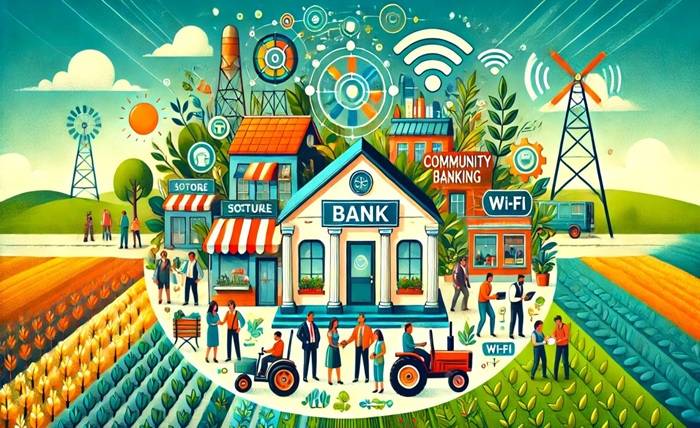
Between 1990 and 2024, the number of banks in the United States dropped from over 14,000 to fewer than 4,600. Mergers swallowed small institutions. Regulators closed others. Branch networks contracted as national chains decided that some towns were not worth serving. Through all of that, community banks survived, and they still originate over 35% of every small business loan in the country. That resilience is not accidental. It reflects a banking model built on relationships, local reinvestment, and the kind of personal service that community banks throughout Idaho and the rest of the country continue to deliver.
The numbers behind community bank lending
Community banks represent 97% of all U.S. banking institutions, roughly 4,455 out of 4,593 total. Despite that overwhelming count, they hold only about 20% of total bank assets because each one operates at a fraction of the scale of a JPMorgan Chase or Bank of America. What they lack in asset size, they compensate for in lending concentration.
FDIC data shows community banks hold 30% of all commercial real estate loans, over 35% of small business loans, and 70% of agricultural loans. These are the lending categories that national banks often treat as secondary to consumer credit cards and corporate finance. For small businesses, farmers, and commercial property owners, community banks are the primary source of capital and financial accessibility.
Community bank loan growth hit 5.1% year over year in the fourth quarter of 2024, more than double the industry-wide rate of 2.2%. That growth was led by nonfarm commercial real estate lending and residential mortgage portfolios: medical offices, retail spaces, family homes, and mixed-use developments that drive local economy and community development.
Relationship lending versus automated decisioning
The FDIC’s 2024 Small Business Lending Survey documented a fundamental difference in how community banks evaluate borrowers. Community banks are twice as likely as large banks to rely on loan officer judgment rather than algorithmic scoring when making lending decisions.
That distinction matters in practice. An automated system sees a credit score, a debt-to-income ratio, and a collateral value. A loan officer at a community bank sees those same numbers but also knows that the applicant’s business is seasonal, that last year’s revenue dip followed a supply chain disruption, and that the borrower has banked at the institution for twelve years with no missed payments. Context changes outcomes.
For families applying for mortgages, the same dynamic applies. Self-employed borrowers, gig workers, and people with non-traditional income streams often struggle with automated mortgage underwriting. Community banks can weigh bank statements, tax returns, and personal history in ways that rigid scoring models cannot accommodate. The result is broader access to home loans for borrowers who are creditworthy but do not fit a standardized approval template.
How families benefit from local banking
Community banking serves families at every financial stage. Savings accounts for children. Checking accounts with low or no fees. Mortgage lending with local underwriting. Investment guidance through affiliated services. The range of products matches what national banks offer, but the delivery model is built on trust and personal relationships.
At a community bank, the person who opens a savings account for a teenager may be the same person who helps that teenager’s parents refinance their home five years later. Continuity of relationship creates familiarity that reduces friction. Questions get answered faster. Problems get resolved by someone with authority to act, not a customer service representative reading from a script in another time zone.
The Federal Reserve’s 2024 Economic Well-Being report found that 6% of U.S. adults remain unbanked, with rates climbing to 22% for households earning under $25,000 and 13% for adults aged 18 to 29. Community banks address this gap through accessible account structures (free checking, low minimum balance deposits) and financial education programs designed to bring underserved populations into the banking system. Credit union membership requirements exclude some of these populations, making community banks the more broadly accessible option.
Small businesses and access to capital
Small businesses depend on available credit to manage cash flow, purchase inventory, hire employees, and support growth. The relationship between a small business and its bank is one of the most consequential financial partnerships the business will have.
Community banks structure that relationship through layers of interaction. A business checking account leads to a line of credit. Regular deposits build a track record that supports a future equipment loan. The loan officer who approved the first credit line is the same person reviewing the application for a commercial mortgage three years later. Each transaction adds data and trust to the relationship.
National banks offer small business lending too, but the approval process routes through centralized underwriting teams that evaluate applications without local context. A business in a growing Idaho town may look identical on paper to one in a declining market elsewhere, but the local loan officer at a community bank understands the difference.
The deposit reinvestment cycle
When customers deposit money at a community bank, those funds stay in the local lending pool. The bank uses deposits to fund loans to other community members: a mortgage for a family, a construction loan for a new restaurant, working capital for a farm preparing for planting season. This cycle of local deposit and local lending is the fundamental economic engine of community banking.
National banks operate differently. Deposits collected at a local branch of a national chain flow into a centralized pool and get deployed wherever the bank’s risk models and return targets dictate. A deposit made in Boise might fund a corporate bond purchase in New York. A deposit at a community bank funds a business loan in the same town, supporting local economic development directly.
Community banks reported net interest margins of 3.44% in the fourth quarter of 2024, increasing for the third consecutive quarter. That margin supports the lending capacity that keeps local capital circulating through communities experiencing growth and new business formation.
Financial stability of the community banking sector
FDIC figures for 2024 show that 93% of community banks remained profitable, with aggregate return on assets at 0.95% and return on equity at 9.60%. Reserve coverage ratios stood at 179.7%, well above the pre-pandemic average of 129.4%. Only 3.46% of all banking institutions were classified as unprofitable, and the FDIC listed just 60 “problem institutions” at year-end.
Community banks reported annual net income of $25.9 billion in 2024. While that represented a 2.4% decline from the prior year (driven by higher provision expenses and noninterest costs), the sector remains well-capitalized and stable. Leverage ratios for community banks electing the Community Bank Leverage Ratio framework stood at 12.18%, comfortably above regulatory minimums.
Why consolidation has not eliminated community banks
The reduction from 14,000 banks to 4,600 over three decades was driven largely by mergers among mid-sized institutions and closures of undercapitalized banks. Community banks that maintained strong capital ratios, conservative lending standards, and loyal deposit bases weathered the consolidation wave.
The survivors have adapted. Nearly 50% of community bank leaders surveyed said their institutions are recognized as innovative within their communities. Over 90% plan digital transformation initiatives, upgrading branches and digital platforms simultaneously. Twenty percent are pursuing fintech partnerships for services like instant payments and automated loan processing.
For families and small businesses evaluating where to bank, the community banking sector offers something that decades of consolidation, technology disruption, and competitive pressure have not diminished: a financial institution that knows its customers, lends locally, and operates as a permanent part of the community it serves.