

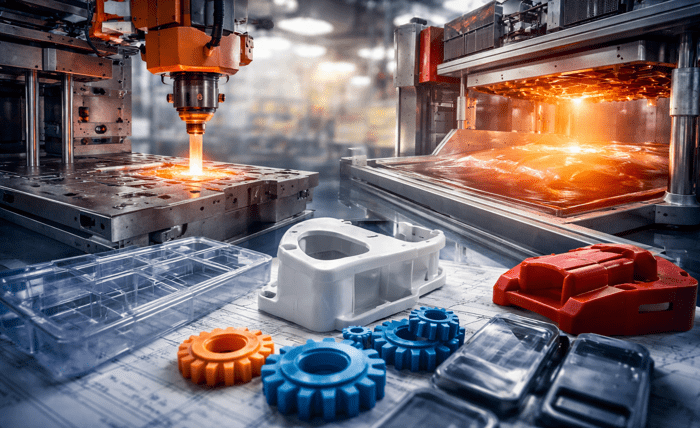
Manufacturing with plastics has forever changed how products are styled and made, giving manufacturers incredible flexibility, productivity, and affordability ranging from daily consumer items to industrial components. The method used to shape the plastic materials in order to produce a plastic part will determine both the quality of the final product and how quickly and in what quantities they are produced. The most commonly used methods of shaping plastics are injection molding, thermoforming and heavy-gauge variants of both processes. Each of these methods has its own advantages and applications, making them great necessities in today’s manufacturing world. With each advancement in technology, manufacturers will be able to continue to produce more complex and precise plastic parts. These advances in technology will also lead to improved sustainability through improved use of materials and less waste throughout the manufacturing process.
The Precision Power of Injection Molding
Rubber and plastic parts can be made using the process known as injection molding. Injection molding allows for large quantities of detailed, high-quality and uniform parts to be produced at one time. The process works by injecting melted rubber or plastic material into a mold that has been precisely designed to create a final product. After the material has cooled, it can be removed from the mold and used as-is or further processed. Injection molding’s complex shapes are not able to be produced as quickly or efficiently by other manufacturing methods.
Businesses seeking a reliable partner for producing high-quality plastic components often turn to an injection molding company. These experts specialize in optimizing material selection, mold design, and production efficiency, ensuring that each component meets strict quality standards while minimizing waste.
If you partner with the right manufacturer for your production processes, then your production cycle time and material cost will be reduced. Therefore, injection molding also becomes a better option for large quantities of plastic manufactured through this process. The advancements in automation and mold technology will continue to create new designs out of plastics through innovation.
Thermoforming and Heavy-Gauge Thermoforming: Versatile Solutions
With multiple formats to produce, plastics can also be thermoformed using heat to soften the plastic sheets, either through conduction or convection. As the sheets are heated, they can be pressed into a mold where they will take the shape of the mold. After the sheets have cooled, they will keep the shape that they have been formed into. This makes them great for lightweight containers, trays, and panels.
For more robust applications, heavy-gauge thermoforming is used. This variant works with thicker plastic sheets, producing strong, durable parts for equipment enclosures, vehicle components, and protective packaging. Companies seeking innovative solutions in this space often rely on a skilled thermoforming company to handle both standard and heavy-duty projects, offering expertise in design, material choice, and precision forming. By leveraging advanced thermoforming techniques, manufacturers can create highly customized parts with consistent quality. Furthermore, this process enables faster prototyping and lower tooling costs than other manufacturing methods.
Choosing the Right Process for Your Product
There are many things to take into account when choosing a manufacturing process to produce your product including complexity, material, production volume, and costs. Injection molding works best for mass production of complex parts while heavy-gauge thermoforming works best for producing larger, simpler products with high levels of durability. By collaborating with manufacturers and effective planning you can better optimize your production, accomplish fewer mistakes, and reduce costs. As new materials and technologies become available you can also create more innovative designs and improve how your product works.
Conclusion
Plastics manufacturing is always looking forward – there is an incredible amount of change and improvement happening in the industry as new technologies emerge. Injection molding and thermoforming are among the most widely used technologies for creating everything from small, high-precision parts to large, durable panels. Finding a partner or supplier with industry experience working with both of these technologies will provide your business with the right combination of quality, efficiency, and design support to successfully take your idea for a plastic part or product from concept through to production.