

From industrial processes to state-of-the-art scientific systems, accurate temperature measurement is key to efficiency, quality, and safety. High precision and stability makes resistance temperature detectors well-suited for manufacturing applications where slight temperature changes can modify operation. By leveraging them effectively, not just reliability can be assured, but also system performance can be enhanced while minimising downtime and supporting improved operational outcomes across manufacturing, research and critical applications.
This post discusses the applications and the best practices of RTDs involved in designing a trustworthy industrial system.
Understanding Resistance Temperature Detectors
A resistance temperature detector is a temperature sensor that utilises the predictable relationship between a metal’s electrical resistance and temperature. An RTD element has a positive temperature coefficient, meaning it gives an accurate measurement as its resistance increases with an increase in temperature. The common materials include platinum, nickel, and copper. Nickel and copper provide this economic alternative having good linearity in a limited temperature range, while platinum gains the edge due to its high stability and wide temperature coverage. The essential characteristics of resistance temperature detectors including high accuracy, nearly linear operation, and long-term stability render this instrument as one of the most utilised precision temperature-measuring instrument used in various applications.
Key Applications of RTDs
Some common industries that are primarily enabled by resistance temperature detectors are:
1. Industrial Automation
It used to be the resistor temperature detector with a set of regular connectors for precise temperature control of processes such as chemical production, food manufacturing, and material fabrication to reduce waste and enhance quality. They also serve in making sure that the following batches of manufacturing have the same product specs.
Additionally, the incorporation of real-time tracking enables the detection of problems, making it easier to prevent further downtime, thus increasing operational efficiency overall.
2. HVAC Systems
These sensors provide the optimal heating, ventilation and air conditioning ( HVAC ) for both indoor and outdoor comfort and efficiency. This enables precise climate control in commercial and residential buildings.
3. Laboratory and Research
Resistor temperature detectors provide a known temperature for experiments, chemical reactions, and materials testing. They help ensure consistency and reliability in the data for critical research efforts. They also allow to stabilise the reference for temperature, thereby facilitating material science, biology and chemistry studies with high fidelity.
4. Aerospace and Automotive
The RTDs span a wide safety and performance spectrum from engine monitoring to battery management to climate control system applications. Crucial to preventing overheating and increasing fuel efficiency, the extremely efficient performance of these devices under extreme conditions makes them irreplaceable in aerospace systems, ensuring passenger safety and the success of the flight mission.
This integration of the device results in increased reliability, reduced maintenance, and stable control of process variables, where greater efficiency, safety, and longer life span of the system are the key requirements.
Designing Reliable Systems with RTDs
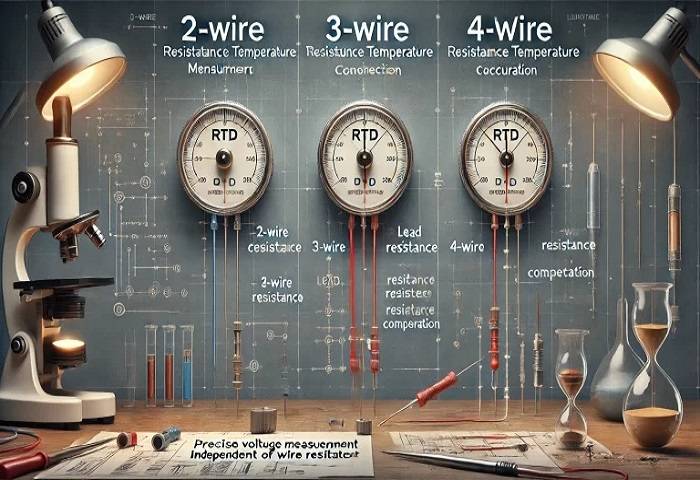
- Reliable systems capable of using resistance temperature detectors require foresight at every stage. Correctly choosing the type – 2-wire, 3-wire, or 4-wire configurations is essential. Although 2-wire RTDs are straightforward and cost-effective, 3-wire and 4-wire designs include compensation for lead resistance, providing accurate measurements even at long distances.
- Placement also matters a lot. Also, avoid heat sinks, heavy vibration, or rapidly changing temperature zones, as these can distort the device readings. If they are integrated properly with controllers and data acquisition systems, signals will not be degraded, and the data will remain relational to the actual physical value. Calibration methods (e.g., reference standards and automated routines) ensure stability.
- The reliability of the system is enhanced with strict adherence to the best practices like some of the factors such as low thermal gradients, good quality of materials and electrical connection are essential, which also contributes to the reliability of the system. Thoughtful design enhances performance and longevity.
Typical Challenges and Solutions to Those Challenges
The use of compensated RTDs, even those with extremely high accuracy, will introduce difficulties that can impact the overall reliability of the system.
- When set up too close to other equipment, readings can be affected by signals and electrical noise from all nearby electronics, while long wire runs can pick up resistance leading to false readings.
- Environmental threats such as humidity, shaking, and extremely high/low temperatures.
- Some great examples of either defensive measures or best solution are: shielding, grounding, protective housings, and regular device maintenance.
If these problems are avoided, it can be ensured that the device always provides correct and reliable measurements, regardless of the condition.
Recommendations for Long-term Stability
- A flexible RTD calibration schedule may identify the drift in order to sustain the performance of the RTD.
- Preventing signal errors and extending sensor life span by operating under a proper connection type and/or materials.
- Constantly monitoring performance leads to early identification of problems.
- RTD based systems are the systems designed to comply IEC and ASTM specifications, as these systems are most widely used around the world for maximum safety, precision and accuracy.
Final Words
RTDs, when designed properly, are built-in devices for accurate, safe, and efficient operation within industrial, research, and automotive applications. When the right one is chosen, installed properly, and maintained regularly, you will enjoy the optimal output and a long lifespan. with years of experience, skill, and expertise, Tempsens delivers quality instruments and custom-made solutions making it a trusted partner of choice in accurate and effective temperature measurement systems with high performance, precision, and reliability.